
Restructuring Changes More Than Reporting Lines
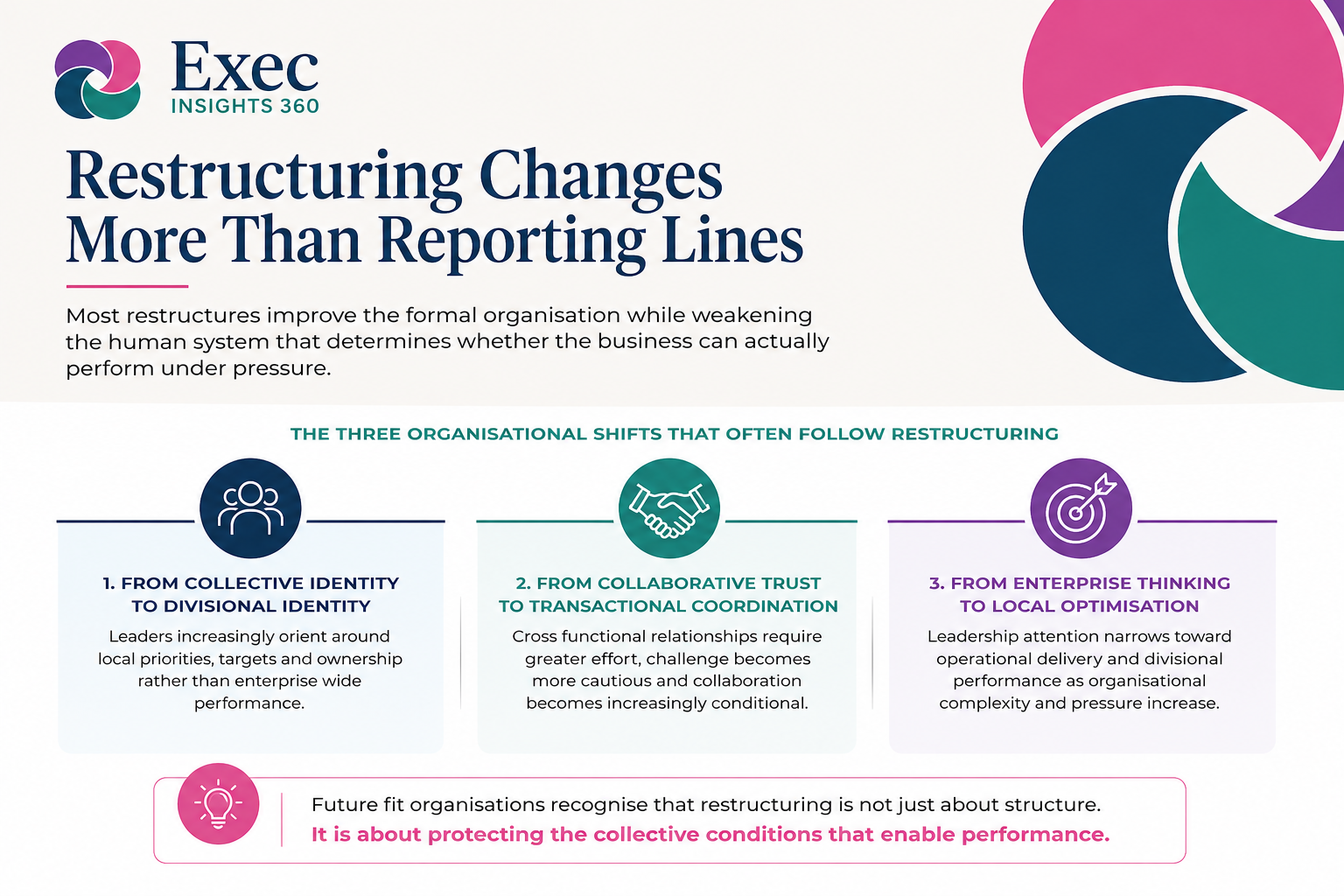
Most restructures are introduced with a clear commercial rationale. Greater accountability, faster decision making, improved efficiency and stronger customer focus have become familiar priorities for organisations navigating increasing complexity and market pressure.
What receives far less attention is the effect restructuring has on the human system of the organisation itself.
Because while reporting lines may become clearer, leadership teams often begin experiencing something very different beneath the surface. Collaboration requires more effort. Decision making becomes increasingly transactional. Leaders orient more strongly around divisional priorities. Collective ownership starts giving way to local optimisation.
The language inside organisations slowly changes from our business to my division, my targets and my people.
Most restructures improve the formal organisation while weakening the collective conditions required for long term organisational performance.
When Collective Identity Starts to Fragment
One of the least understood consequences of restructuring is the erosion of collective identity.
The strongest leadership teams operate with a shared understanding that they are collectively responsible for the wider enterprise rather than solely accountable for their own area of operation. This shapes behaviour in commercially important ways. Information flows more openly. Cross functional problem solving happens faster. Leaders make decisions with greater awareness of organisational impact rather than local gain.
Structural redesign can unintentionally disrupt this. As accountability becomes more localised and incentives become increasingly divisional, leaders naturally focus more heavily on what they directly control. This shift is rarely deliberate. It develops gradually through targets, reporting structures, operational pressure and performance expectations.
Over time, organisations begin optimising locally rather than collectively.
Why Collaboration Changes Under Pressure
This tension becomes most visible during periods of sustained pressure. Collaboration remains relatively straightforward when workloads are manageable, priorities are stable and growth is strong. The real test of organisational maturity emerges during uncertainty, operational complexity and competing priorities. This is the point at which collective intelligence either strengthens or deteriorates.
Research from the World Economic Forum continues to identify collaboration, adaptability and cross functional coordination as critical capabilities shaping future competitiveness. McKinsey research similarly highlights the relationship between organisational health, alignment and sustained performance.
Yet many organisations unintentionally create conditions that narrow leadership attention precisely when greater enterprise thinking becomes most important.
Leadership teams become increasingly operationally focused. Strategic thinking time reduces. Coordination consumes greater energy. Leaders begin protecting local priorities more carefully because the wider organisational environment feels more complex and ambiguous.
The organisation may still appear aligned structurally while becoming increasingly fragmented behaviourally.
The Leadership Challenge Beneath the Structure
This helps explain why some restructures succeed operationally while weakening the quality of collective leadership across the business.
The issue is rarely capability alone. More often, the underlying challenge sits within the organisational conditions shaping leadership behaviour.
Future fit organisations recognise that restructuring is not simply an operational exercise involving reporting lines, accountability maps and spans of control. It is a systemic intervention into trust, collaboration, leadership behaviour and collective identity.
As complexity continues increasing across industries, organisational performance will depend less on isolated expertise and more on how effectively leadership teams think, operate and make decisions together across the enterprise.
And why structures matter, the quality of collective leadership matters more.
If you would like to sign up to the latest edition of 'Future Fit Dispatches', our Leadership Insight newsletter, feel free to leave your contact details here.