
When Organisational Strengths Become Constraints
Why caring organisations can find accountability harder as they grow
Many organisations are trying to preserve trust, loyalty and humanity while also increasing pace, ownership and performance.
The difficulty is that conversations can be delayed in the name of ‘care’. They tend to become heavier, more emotionally loaded and harder to resolve over time. What starts as a genuine desire to protect people, relationships and culture can gradually create the very ambiguity that makes trust harder to sustain.
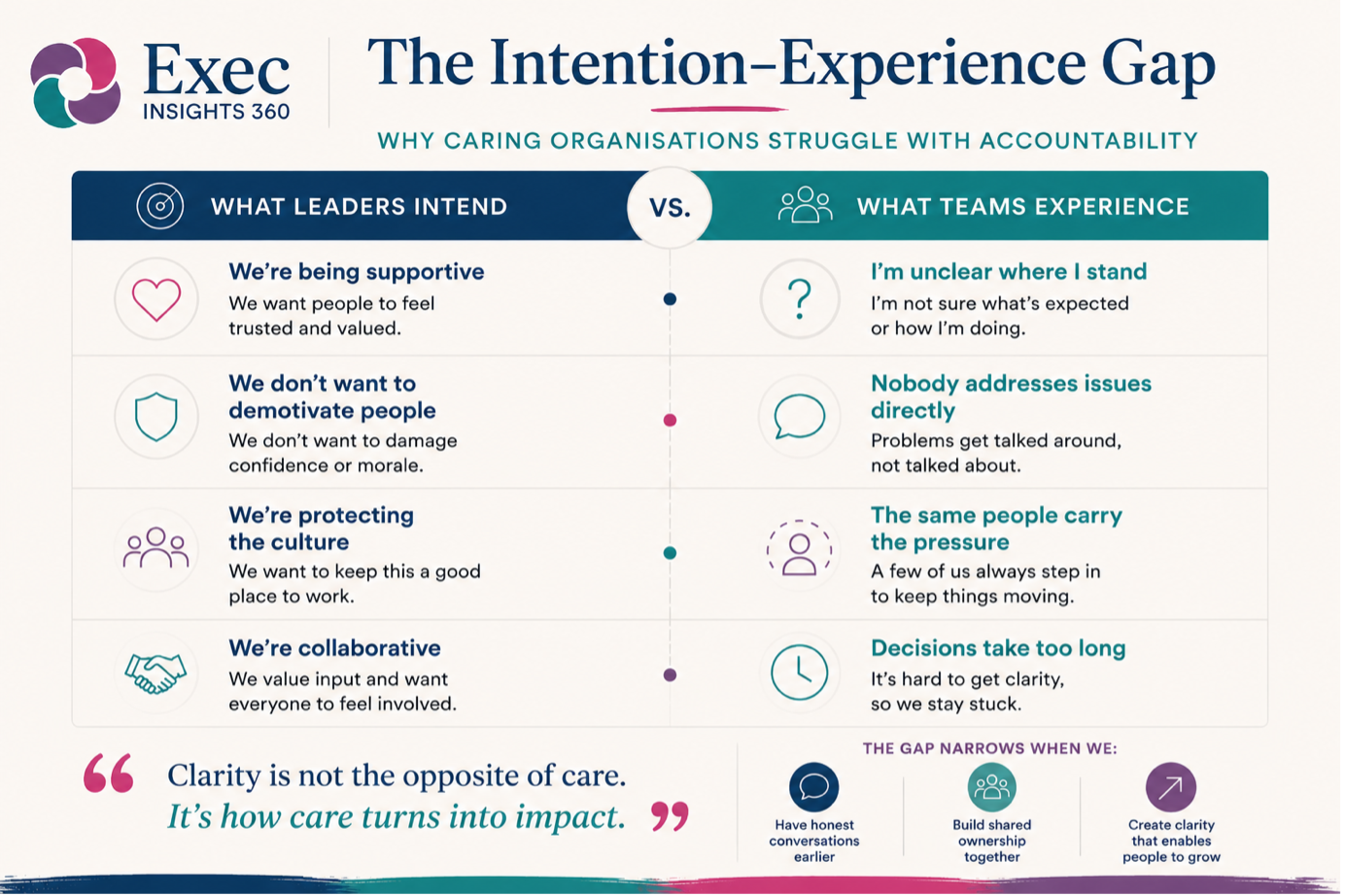
The tension many leadership teams recognise immediately
“We don’t want to become really lovely and then suddenly go in super hard because we’ve left it too late.” Shared by a senior leader with me recently.
Many organisations wrestling with accountability today are not uncaring environments. In fact, they are often full of highly committed people who genuinely want to create supportive, human cultures where individuals feel trusted and valued. Teams work hard for one another, leaders carry enormous responsibility personally and loyalty runs deep. These are qualities most organisations want to preserve.
The challenge is that organisational strengths do not always scale unchanged. Some of the very behaviours that helped create a positive culture can, over time, begin to produce unintended consequences.
Conversations become softened around the edges because leaders are trying to preserve relationships and confidence. Expectations remain slightly unclear because nobody wants to demotivate good people who are already working hard. The instinct to protect people, entirely understandable in itself, can gradually make it harder to create the clarity those same people need.
Eventually, organisations find themselves carrying a level of ambiguity that becomes both emotionally and operationally exhausting. One executive described it recently as "death by collaboration", where extensive consultation was creating inclusion but very little movement.
The organisational cost of unclear accountability
Gallup's workplace research has consistently found that employees who clearly understand what is expected of them are significantly more engaged, productive and likely to remain with their organisation. Yet despite this, role clarity remains one of the most persistent challenges in employee engagement data. McKinsey's organisational health research points in a similar direction, highlighting the importance of clear decision-making, accountability and leadership alignment, particularly during periods of growth and complexity.
What is striking, however, is that many organisations experiencing these challenges are not short of commitment, effort or goodwill. The issue is rarely that people do not care. More often, ownership becomes blurred, priorities compete for attention and leaders find themselves stepping in to resolve issues that others could, and perhaps should, be addressing themselves.
One leader reflected candidly that people had started assuming the CEO would eventually step in and resolve issues anyway.
That dynamic is more common than many organisations would like to admit, particularly in founder-led and entrepreneurial businesses. Leaders who have built trust through visibility, responsiveness and personal involvement often discover that the same behaviours can become harder to sustain as organisations grow. The very leadership qualities that accelerated progress in one phase can begin to limit it in the next.
Accountability becomes difficult when loyalty runs deep
One of the most emotionally complex leadership realities is recognising that someone can be deeply valued and no longer the right fit for the next phase of organisational growth.
A senior executive recently described the discomfort of needing to performance manage an individual who had effectively helped save the business during an earlier period of crisis. The person had been highly trusted, deeply loyal and enormously hardworking, but the role had evolved and now required a different level of leadership capability.
This is where organisational strengths can begin to create unintended constraints.
Loyalty, trust and shared history are often the foundations of strong cultures. Yet they can also make it harder to acknowledge when roles, capabilities or organisational needs have changed.
Performance conversations are often wrapped up in gratitude, care and a genuine desire to do right by people who have contributed significantly to the organisation's success. Leaders remember who stepped in when pressure was high, who carried additional responsibility and who helped protect the culture during challenging periods.
The difficulty is that uncertainty rarely remains contained. High performers begin compensating for weaker ownership elsewhere in the organisation. Frustration accumulates, decision-making slows and leaders find themselves drawn back into operational detail because they no longer trust that accountability exists consistently across the system.
The challenge is not the presence of care, loyalty or trust. The challenge is recognising when the very qualities that helped build the organisation are making it harder to evolve.
The organisations handling this best are becoming clearer, not colder
The organisations navigating this tension most successfully are not becoming harsher, more bureaucratic or less human. If anything, they are becoming more intentional about clarity, expectations and feedback because they recognise these are not alternatives to care but expressions of it.
People know where they stand. Expectations are discussed openly. Feedback happens earlier, before frustration accumulates. Leaders become more comfortable talking honestly about capability, growth and readiness for future roles, recognising that clarity creates confidence far more often than it creates anxiety.
Feedback delivered early enough for someone to act upon it is usually far kinder than allowing ambiguity to continue for months.
Another leader recently shared: "We all need to get better at having those conversations, but we also don't want to lose what makes this a good place to work."
Perhaps that is one of the defining leadership tensions many organisations are now trying to navigate. The challenge is not choosing between care and accountability. It is preserving the qualities that make a culture strong while ensuring those same qualities do not become constraints on the organisation's ability to grow, adapt and perform.